
Follow Alexandria on twitter @alexandriablog3
The decade of the Unicorns
Ever since venture capitalist, Aileen Lee coined the term “unicorn” to refer to private companies worth +$1 billion in 2013, the startup community has fallen in love with it. There were 39 unicorns at that time. Today, there are more than 500 unicorns around the world, many of them galloping through unprofitable roads.
Becoming a unicorn has turned into Holy Grail for entrepreneurs, and the obsession of VCs who keep flooding the market with billions of dollars hoping to fund the next Facebook. But what about the rest of the mortals? Do all startups need to follow the unicorn-way?
Six years after the term was coined, ‘unicorn’ means much more than what it originally meant to describe. It ended up representing a whole era, filled with exuberance, greed, and record-setting valuations. Words like ‘moonshots’, ‘hyper-growth’, and ‘winner-takes-all’ became indicative terms of what the investor community would expect from every aspiring entrepreneur.
Unicorns such as Uber entered the public markets galloping at high speed, only to find their new barn to be extremely unwelcoming. Fred Wilson called it the “Great Public Market Reckoning”. Public markets are not having it. Despite the upside potential, they want to see profitable companies with sound unit economics or at least a clear path to profitability before buying into these massive valuations.
It seems like in today’s startup scene there is no room for any creature other than longing unicorns… But 2020 may be the year when the whole dynamic starts to change. Investors and entrepreneurs alike are realizing that there is more to a sustainable company than just speed and capital. As crazy as it may sound, profits and business fundamentals are becoming fashionable once again; but let’s not put the cart before the horse (put intended). What do I mean when I vaguely talk about unicorns?
The Unicorn-Way
The internet revolution has created a plethora of so-called winner-takes-all markets. They are characterized by strong network effects and usually lead to natural monopolies. In the unicorn era, being first usually represents a huge competitive advantage; one of Mark Zuckerberg’s motto “Move Fast and Break Things” puts it eloquently. The easiest shortcut to accomplishing this is capital.
The availability of cheap capital in a historically low interest rates environment, paired with the natural tendency of certain tech business models to have a huge upside potential has triggered an unprecedented growth in the size of private investment rounds.
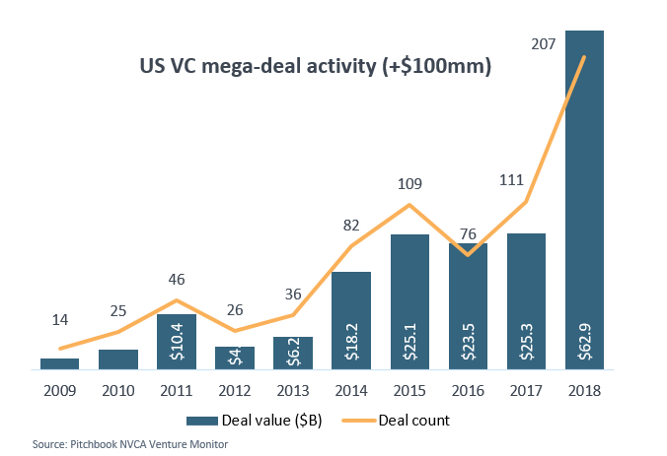
The combination of these and other factors created an explosive cocktail that led to massive valuations achieved in a very short time span, more unprofitable unicorns filing for an IPO than ever in recent history, and multiple high-profile firms such as WeWork and Uber struggling to justify their bloated valuations (WeWork had to slash theirs by +80% after failing to tap into the public markets).
So much for the rarity of unicorns… The whole system lends itself to be a unicorn-making machine: The idea of becoming the next Amazon or Google acts as a big carrot at the end of the stick; too much money chases too few suitable ideas; every startup tries to grow as big as possible, as fast as possible; the huge upside potential justifies the high valuations, and those same valuations get even higher after astronomical capital injections are made by new investors to increase their odds of materializing the upside. That’s precisely why Reid Hoffman, Co-Founder of LinkedIn would encourage certain startups to achieve “lighting growth by prioritizing speed over efficiency” in a term he called “blitzscaling”.
Horse startups
What if instead of focusing on legendary creatures that, by definition, do not exist, we start looking at their *real* cousins? Horses are equally powerful startups that are not mythological or don’t require a grand slam to be successful (few startups succeed, and even less startups fit the unicorn-way approach). Horses focus on their business fundamentals and not just growth for the sake of growth; funding for the sake of higher valuations. Horses are profitable private companies valued at +$1 billion*.
Just as the term ‘unicorn’ is not perfect, the term ‘horse’ is far from it too. I’m arbitrarily choosing a definition for horse startups that would be easy to digest, but the intention is to create awareness that right now, the unicorn segment is over-represented both by investors and entrepreneurs, and that not every project should mold to the unicorn way as described in this article.
The by-product of growing too quickly and trying to grab as much market share as possible is burning through massive amounts of cash and piling up losses. That right there is the difference between a unicorn and a horse. Unicorns used to be rare and unique. Now, every startup seems to be following that same path, including firms with business models that are not suitable for this approach (even the author of ‘Blitzscaling’ felt compelled to write about when firms should not implement these hyper-growth tactics). Let’s take a look at the top 10 largest unicorns that IPO’d in 2019. Only 1 out of 10 fit our definition of horse**.
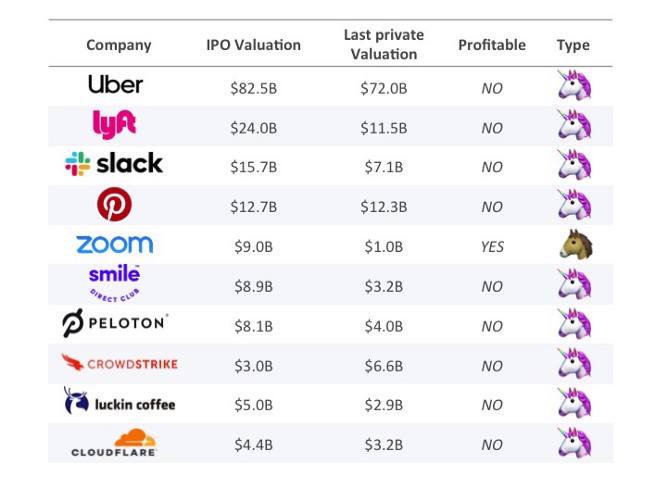
Regardless of the precise definition of horse startups, what’s interesting to note here is an incipient shift that’s happening in the investor community. It looks like this could be a pivotal moment.
Investors are starting to ask themselves if this is the best way to allocate their capital. Entrepreneurs, too used to dancing to the unicorn tune, begun questioning if they should necessarily pursue the greatest amount of money in the least amount of time, and started focusing on profits early on. Some of the renowned status-quo VCs started asking tougher questions and placing greater importance on being more fiscally responsible. Other investors propose alternative models where they fund startups with a focus on sustainable growth and profitability, and not with the intent of doing whatever it takes to raise the next round. A few go as far as rejecting initial funding all together, preaching that startups should begin their journey by bootstrapping themselves instead of raising big checks right off the bat. All of these approaches have their own merits and should co-exist, but none of them should displace the others or impose a blanket path to creating valuable companies.
The main purpose of this note is to acknowledge this change in sentiment and reappearance of the non-unicorn entrepreneurial projects and investors. Horse and unicorn startups may be biologically similar (both may end up being valued at US$1 billion) but the way they get to that valuation is different. Not all valuable companies are created equal.
This is a humble attempt to re-legitimize those startups that do not fit the unicorn-way model. There’s a time and place for unicorns, there’s a time and place for horses, and there’s a time and place for any other startup that follows a different approach to achieve their own definition of success. As the VC industry matures, it should be able to accommodate all alternatives and provide the necessary resources, accordingly.
I now welcome you to the Horse club.
**Profitable in this note means positive EBITDA. The choice of metric to determine profitability should be an article in itself. Borrowers of the term should feel free to use EBITDA, FCF, Net income, or a combination of these and other metrics.
**Profitability is based on the last EBITDA reported on the complete fiscal year before going public (2018)
 Site Title